Goo in the Classroom: Why Science Teachers Are Obsessed With Slime Right Now
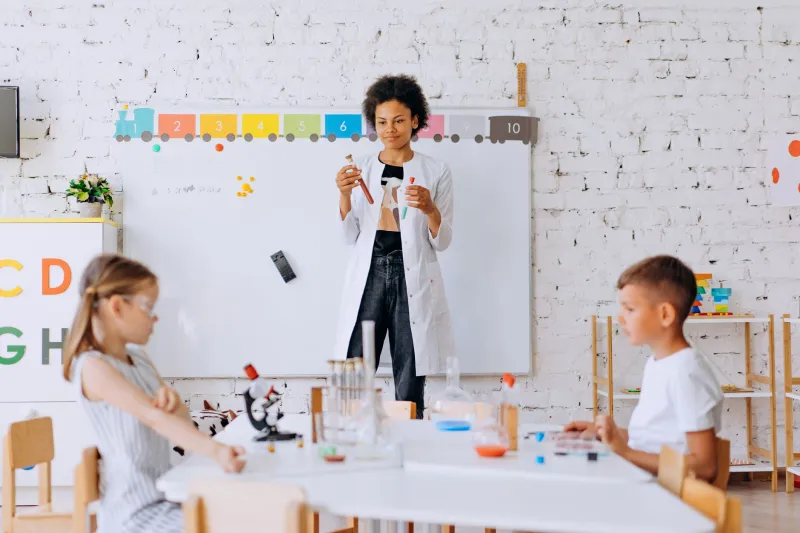
Walk into Ms. Rivera's fifth-grade science class at a public elementary school in Queens on a Tuesday afternoon, and you might think something has gone wonderfully wrong. There are bowls everywhere. Kids are elbow-deep in glistening, stretchy goo. Someone just shouted, "Mine turned into a bouncy ball!" And the teacher? She's grinning from ear to ear.
This is not chaos. This is chemistry.
"The moment I brought slime into my curriculum, everything shifted," says Rivera, who has been teaching elementary science for eleven years. "Kids who barely looked up from their desks were suddenly asking me questions I wasn't expecting — like why the molecules were linking together, or what would happen if they changed the ratio of activator. That's real scientific curiosity, and slime unlocked it."
Across the country, educators are catching on to something that the kids at Slime Expo NYC have known for years: slime is seriously compelling. But beyond the satisfying squish and the Instagram-worthy textures, there's a surprisingly rich layer of educational value hiding inside every batch.
The Science Is Actually Real (And Kind of Mind-Blowing)
Here's the thing most parents don't realize when their kid comes home with glue-covered hands: making slime is a legitimate chemistry lesson. At its core, slime is a polymer — a long chain of molecules that forms when polyvinyl alcohol (found in white school glue) reacts with a borate ion (from borax, contact lens solution, or baking soda and saline). That reaction creates cross-links between molecules, which is exactly why slime behaves like both a liquid and a solid depending on how you handle it.
Dr. Priya Nambiar, a learning specialist based in New Jersey who works with middle school students, uses slime as an entry point into polymer science and non-Newtonian fluid dynamics — topics that would typically cause a room full of twelve-year-olds to check out immediately.
"When I tell kids we're going to study non-Newtonian fluids, I get blank stares," she laughs. "When I tell them we're making slime and then figuring out why it works, I can't get them to stop talking."
She's developed a classroom activity where students act as "slime scientists," adjusting one variable at a time — the amount of activator, the temperature of the water, the type of glue — and recording their observations like proper lab researchers. It maps directly onto Next Generation Science Standards (NGSS) for grades 3 through 8, covering everything from physical properties of matter to designing and testing experiments.
A Recipe That Actually Teaches Something
For teachers who want to try this at home or in the classroom, here's a simple slime recipe that doubles as a chemistry demonstration:
Basic Polymer Slime (Curriculum Edition)
- 4 oz of white PVA school glue
- 1/2 cup warm water
- 1/2 tsp baking soda
- 1 tbsp saline solution (must contain sodium borate)
- Food coloring (optional)
Instructions: Mix the glue and warm water until fully combined. Add food coloring if using. Stir in the baking soda. Slowly add the saline solution, one teaspoon at a time, stirring constantly until the slime pulls away from the bowl. Knead until smooth.
The teaching moment: Before mixing, ask students to predict what will happen when the activator is added. After mixing, have them describe the texture using scientific vocabulary — viscosity, elasticity, cohesion. Then challenge them to adjust the recipe and document what changes. Boom. That's the scientific method, right there in a bowl.
More Than Just Molecules: The Mental Health Angle
Here's where it gets really interesting. Teachers aren't just using slime to hit science benchmarks — they're using it to support student wellbeing, and the results are hard to ignore.
Marcus Thompson, a school counselor at a Brooklyn middle school, started incorporating sensory slime activities into his social-emotional learning sessions about three years ago. His students — many of whom deal with anxiety, ADHD, and sensory processing differences — responded in ways he didn't fully anticipate.
"There's something about the repetitive, tactile nature of kneading and stretching slime that genuinely calms the nervous system," Thompson explains. "I've had kids who couldn't sit through a ten-minute conversation start opening up during slime sessions. The hands are busy, the brain relaxes, and suddenly they're talking."
This tracks with what occupational therapists have been saying for years about sensory play. Manipulating a tactile material like slime engages the proprioceptive system — the body's sense of its own movement and pressure — which can have a regulating effect on kids who struggle with anxiety or emotional dysregulation. Thompson now keeps a small "calm corner" in his office stocked with different slime textures, from fluffy cloud slime to satisfying crunchy slime, so students can choose what feels right for them on a given day.
What the Classroom Success Stories Look Like
The results educators are seeing aren't just anecdotal warm fuzzies — they're showing up in measurable ways. Rivera reports that her unit test scores on physical science topics improved noticeably after she introduced hands-on slime labs. Dr. Nambiar has seen students who previously avoided group work actively seek out partners for slime experiments. Thompson notes that attendance in his voluntary lunch sessions tripled once word got out that slime was involved.
One story that stands out: a seventh-grader at Dr. Nambiar's school who had been labeled "disengaged" and was struggling with reading comprehension became the unofficial classroom expert on polymer chemistry after a slime unit. He started researching the topic independently, wrote an extra-credit report comparing different activators, and eventually gave a short presentation to the class. "That kid didn't need more worksheets," Dr. Nambiar says quietly. "He needed a reason to care."
Bringing It Home (And Into Your School)
If you're a parent who wants to support this kind of learning, the good news is that slime science is incredibly accessible. A basic slime kit costs next to nothing, the ingredients are easy to find at any craft or grocery store, and there are endless ways to layer in educational concepts depending on your child's age and interests.
For younger kids (ages 5–8), focus on sensory exploration and simple cause-and-effect observations. For tweens, introduce the vocabulary of chemistry and encourage them to run their own experiments. For teenagers, the rabbit hole goes deep — there's real science to explore around viscosity, rheology, and material engineering.
And if you're a teacher looking to bring slime into your curriculum officially, organizations like the American Chemical Society have published educator guides on polymer science that align with Common Core and NGSS standards. You don't have to reinvent the wheel — just add glue and a little borax.
At Slime Expo NYC, we've always believed that slime is more than just a toy. Turns out, the educators who are getting their hands dirty in classrooms across the country agree. Sometimes the messiest lessons are the ones that stick.